The ANDfunction returns TRUE if all its arguments evaluate to TRUE, and returns FALSE if one or more arguments evaluate to FALSE. One common use for the ANDfunction is to expand the usefulness of other functions that perform logical tests.
The IF function and the ANDfunction belong to the logical functions’ library of Microsoft Excel. Both these functions are superheroes in their domain – but when put together, the IF ANDfunction makes an unstoppable superhero duo. In the tutorial below, I will teach you how this function works.
This guide provides a comprehensive understanding of the ANDfunction, starting with basic usage and progressing to more advanced formulas. Let's start simple. For example, consider the ANDfunction shown below.
The ExcelANDfunction lets you test two or more conditions simultaneously. It returns TRUE or FALSE as the output. TRUE only if all the conditions are met FALSE when any of the given condition is not met For example, you can check whether the number in cell A1 is greater than 10 and less than 100. Here’s how the formula will look: =AND(A1>10 ...
Let's look at some practical ways to use the ANDfunction. You can useAND to check if a number in a cell is between two numbers. For example, to test if a number is between 10 and 20 we can use AND as seen in the workbook below, where the formula in cell D5 is:
HowtoUse the ANDFunctioninExcel? To understand the uses of the ANDfunction, let us consider a few examples: Suppose we wish to calculate the bonus for every salesperson in our company. To be eligible for a 5% bonus, the salesperson should have achieved sales higher than $5,000 in a year.
The ANDfunction is a premade function in Excel, which returns TRUE or FALSE based on two or more conditions. It is typed =AND and takes two or more conditions.
This Excel tutorial explains how to use the Excel AND function with syntax and examples. The Microsoft Excel AND function returns TRUE if all conditions are TRUE.
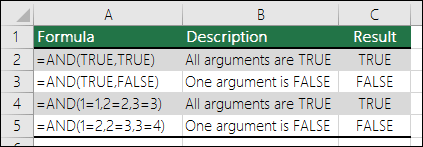 The AND function returns TRUE if all its arguments evaluate to TRUE, and returns FALSE if one or more arguments evaluate to FALSE. One common use for the AND function is to expand the usefulness of other functions that perform logical tests.